 Trusted by healthcare professionals
Difference between U-40 and U-100 Insulin Syringes
If you use insulin syringes, you may notice that they are labelled U-40 or U-100. These numbers refer to the concentration of insulin the syringe is designed to measure—not the size of the syringe or the needle. Using the correct syringe for your insulin is essential. A mismatch between the insulin concentration and the syringe can result in significant dosing errors, which may lead to dangerously high or low blood glucose levels.
What does U-40 and U-100 mean?
The “U” stands for units of insulin per millilitre (ml).
- U-40 insulin contains 40 units of insulin per millilitre
- U-100 insulin contains 100 units of insulin per millilitre
Because U-100 insulin is more concentrated, the same number of insulin units occupies a much smaller volume than U-40 insulin.
For example:
- 10 units of U-40 insulin equals 0.25 ml
- 10 units of U-100 insulin equals 0.10 ml
This is why each syringe is specifically calibrated for one insulin concentration.
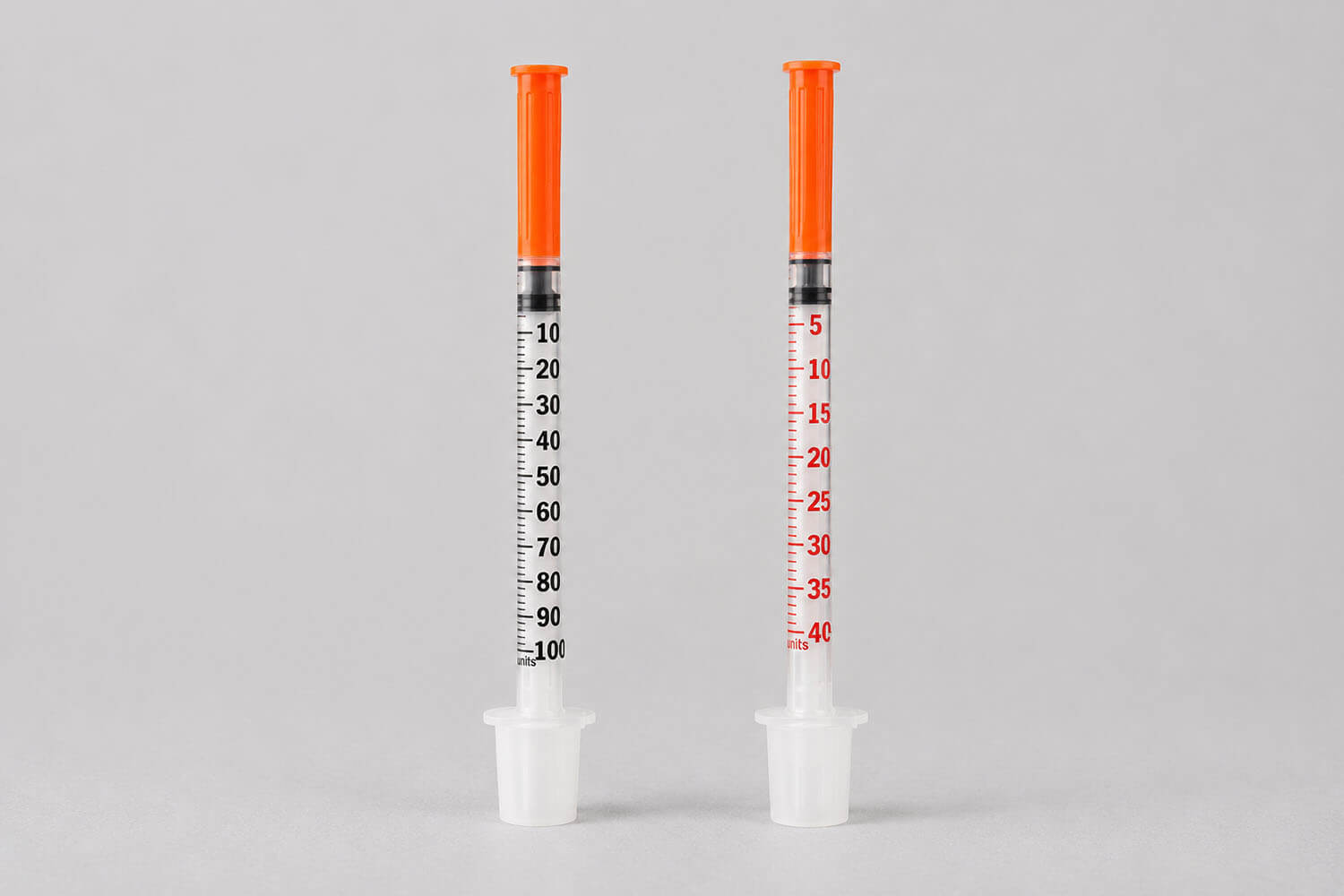
Why are there two different standards?
Today, U-100 is by far the most common insulin concentration for human diabetes treatment. Almost all modern rapid-acting, short-acting, intermediate-acting, and long-acting insulin products are supplied as U-100.
U-40 insulin is much less common for human use but is still widely used in veterinary medicine, particularly for treating diabetes in cats and dogs. Certain veterinary insulin products are manufactured exclusively as U-40 and therefore require matching U-40 syringes.
Can you mix U-40 and U-100 syringes?
No. A U-40 syringe should only be used with U-40 insulin, and a U-100 syringe should only be used with U-100 insulin. Although the syringes may look very similar, the printed unit markings are different because they measure different insulin concentrations.
Using the wrong syringe can result in administering far too much or far too little insulin. For example, drawing U-100 insulin into a U-40 syringe will not deliver the number of units shown on the barrel. Likewise, using a U-100 syringe with U-40 insulin will lead to an incorrect dose.
Always verify both the insulin concentration and the syringe before preparing an injection.
Needle length and gauge
The difference between U-40 and U-100 syringes is not the needle itself. Both types are available with similar needle specifications, including:
Common needle lengths
- 6 mm
- 8 mm
- 12.7 mm
Common needle gauges
- 29G (0.33 mm)
- 30G (0.30 mm)
- 31G (0.26 mm)
Needle length determines how deeply the injection is delivered, while gauge describes the thickness of the needle. These characteristics are independent of the insulin concentration.
Common applications
U-100 insulin syringes are primarily used for human insulin therapy and are suitable for administering most modern insulin formulations prescribed for diabetes. U-40 insulin syringes are mainly used with veterinary insulin products for dogs and cats, although they may occasionally be prescribed for specific human applications in certain countries.
Both syringe types are designed for subcutaneous injections, delivering insulin into the fatty tissue beneath the skin.
How to identify the correct syringe
Always check the packaging before use. Manufacturers clearly indicate whether a syringe is intended for U-40 or U-100 insulin. If you are changing insulin brands or have any doubts about compatibility, consult your doctor, diabetes nurse, pharmacist, or veterinarian before administering your injection.
The key difference between U-40 and U-100 insulin syringes is the insulin concentration they are calibrated to measure. U-40 syringes are designed for insulin containing 40 units per millilitre, while U-100 syringes are intended for insulin containing 100 units per millilitre.