 Trusted by healthcare professionals
Needle length explained
Needles are available in a wide range of lengths, from very short pen needles to longer hypodermic needles used in clinical settings. Choosing the correct needle length is important because it helps ensure that medication is delivered into the intended tissue while making the injection as comfortable as possible. The right needle length depends on the type of medication, the injection technique, and the route of administration—not simply on personal preference.
Needle length determines how deeply a medication is delivered into the body. Short needles are commonly used for subcutaneous injections such as insulin and GLP-1 medications, while longer needles are intended for applications that require deeper penetration, including intramuscular injections.
How is needle length measured?
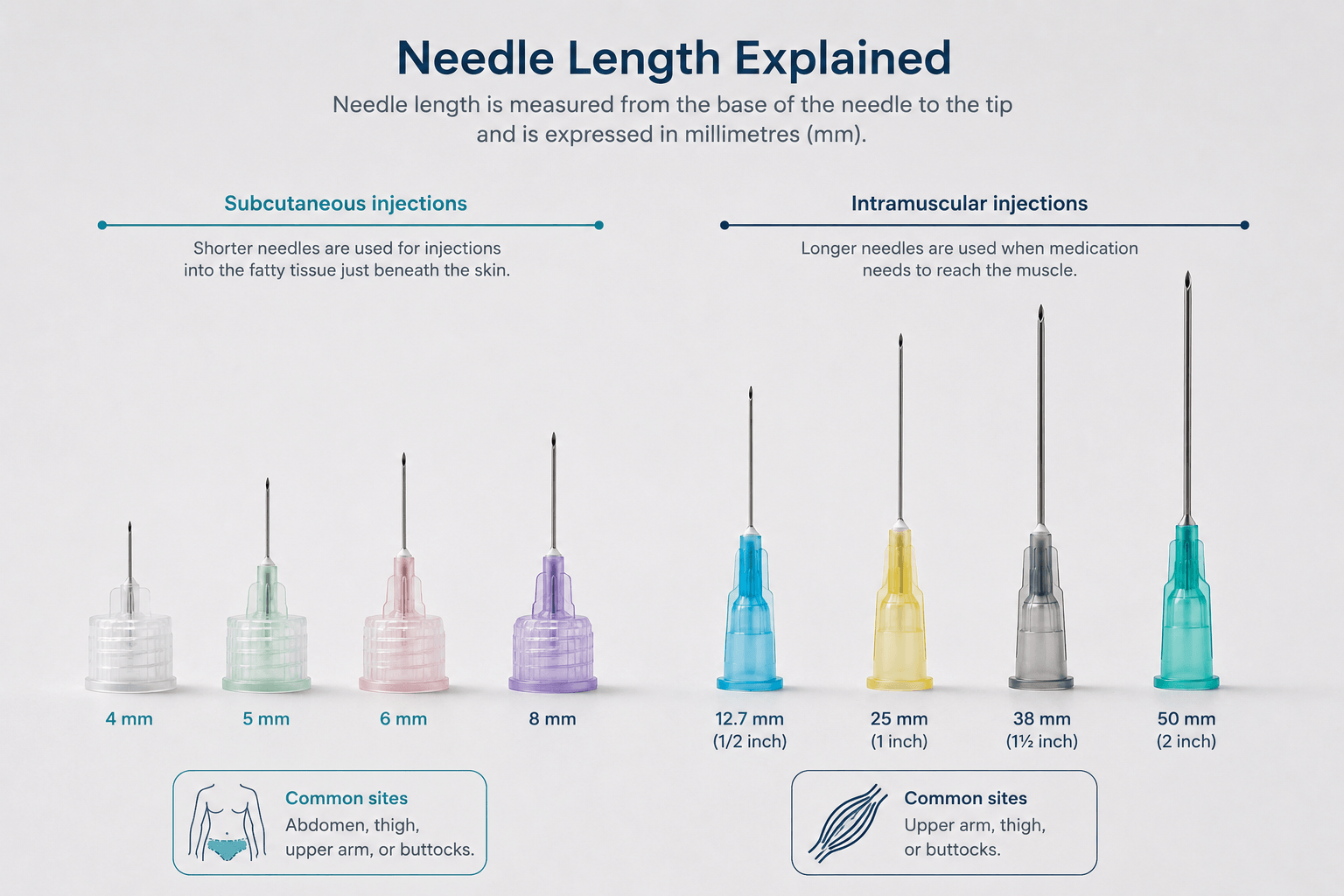
Needle length is measured from the base of the needle to the tip and is usually expressed in millimetres (mm). Common lengths include 4 mm, 5 mm, 6 mm, 8 mm, 12.7 mm, and longer sizes used for specific medical procedures. It is important to remember that needle length and needle gauge are different measurements. Length describes how long the needle is, while gauge (G) refers to the thickness of the needle.
Short needles for subcutaneous injections
Many modern injectable medications, including insulin and GLP-1 treatments, are administered into the fatty tissue just beneath the skin. This is known as a subcutaneous injection. For these medications, shorter needles are often preferred because they are designed to reach the subcutaneous tissue without penetrating the underlying muscle. Today, 4 mm pen needles are widely recommended for most adults and children and are suitable for many body types when used correctly.
Short needles are generally associated with greater comfort while still delivering medication effectively.
Longer needles for other applications
Longer needles are used when medication needs to reach deeper tissue or when the injection method requires it. Examples include:
- Intramuscular injections
- Drawing medication from vials
- Certain vaccines
- Some hormone therapies
- Medical procedures performed by healthcare professionals
Depending on the application, needle lengths of 25 mm, 38 mm, or even longer may be required to safely reach the target tissue.
Does a longer needle hurt more?
Many people assume that a longer needle will always be more painful, but this is not necessarily the case. Injection comfort depends on several factors, including needle gauge, injection technique, injection site, and the medication being administered. Modern needles are manufactured with extremely fine diameters and precision-ground tips to help minimise discomfort during injection.
Always follow the product instructions
Medications are designed to be administered using specific needle lengths. Using a needle that is too short or too long may affect how the medication is delivered. For this reason, always use the needle length recommended by your healthcare provider or specified in the product instructions. If you are unsure which size is appropriate, consult your doctor, nurse, or pharmacist before administering an injection.