 Trusted by healthcare professionals
What Is Gauge? Understanding Needle Thickness
If you are buying pen needles, hypodermic needles or insulin syringes, you will almost always see a number followed by the letter G, such as 30G, 31G or 32G. This refers to the needle gauge, which indicates how thick or thin the needle is. Understanding gauge makes it much easier to choose the right needle for your medication and injection technique. Gauge is simply a way of describing needle thickness. The higher the gauge number, the thinner the needle.
What does Gauge mean?
Gauge (G) is a standardized measurement used to describe the outside diameter of a needle. One detail often surprises people: the higher the gauge number, the thinner the needle. For example:
- A 21G needle is relatively thick
- A 25G needle is thinner
- A 30G needle is very thin
- A 32G needle is even thinner and is commonly used for insulin and GLP-1 injections.
This numbering system can seem counterintuitive at first, but it has been used in the medical industry for many years.
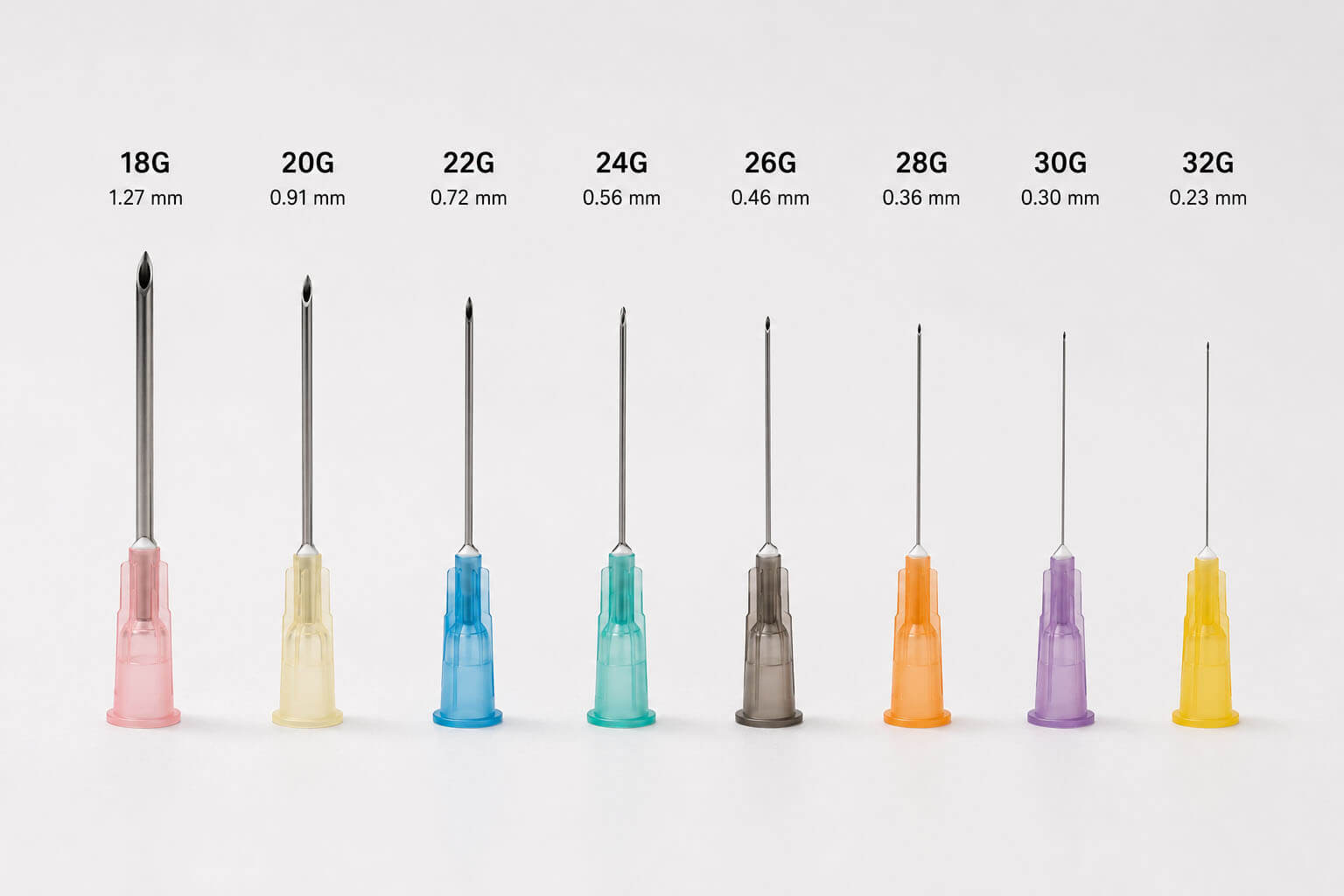
Why does needle thickness matter?
Needle thickness affects both the injection experience and the type of medication being administered. Thinner needles are generally more comfortable because they create a smaller puncture in the skin. They are commonly used for subcutaneous injections such as insulin and GLP-1 medications.
Thicker needles have a larger internal diameter, allowing liquids to flow more easily. They are therefore preferred for thicker medications, drawing medication from vials, or certain intramuscular injections. Choosing the correct gauge depends on your medication, injection method, and the recommendations provided by your healthcare professional.
Gauge to millimetre conversion
Although gauge is the standard way of describing needle thickness, many manufacturers also specify the diameter in millimetres. The table below shows the most commonly used needle gauges.
| Gauge (G) | Outside Diameter (mm) |
|---|---|
| 18G | 1.27 mm |
| 20G | 0.91 mm |
| 21G | 0.82 mm |
| 22G | 0.72 mm |
| 23G | 0.64 mm |
| 24G | 0.56 mm |
| 25G | 0.51 mm |
| 26G | 0.46 mm |
| 27G | 0.41 mm |
| 28G | 0.36 mm |
| 29G | 0.33 mm |
| 30G | 0.30 mm |
| 31G | 0.26 mm |
| 32G | 0.23 mm |
| 33G | 0.21 mm |
| 34G | 0.18 mm |
Small variations may exist between manufacturers, but these values are widely accepted industry standards.
Which Gauge is most common?
For people using insulin pens or GLP-1 injection pens, 31G and 32G are among the most common choices. These needles are designed to provide a comfortable injection experience while delivering medication effectively into the subcutaneous tissue.
Traditional syringes may use gauges ranging from 25G to 30G, depending on the medication and application. Larger gauges such as 21G or 23G are frequently used in hospitals and clinics for drawing medication or administering injections that require a wider needle.